Is tasting Prosecco in Tuscany possible?
If you’re taking a Tuscany wine tour from Florence, and you love the bubbles, you may be wondering if a Prosecco tasting in Tuscany is possible? If you don’t want to read all the article the answer is yes. However to avoid disappointment, I suggest you take the time to read it all. The first thing to know is Prosecco is made in the Veneto and Friuli regions of north east of Italy. So because Prosecco is a protected appellation, it can’t be made in Tuscany or anywhere else for that matter. There’s nothing which prevents making a wine using the same methods and grapes, it just can’t be called Prosecco.
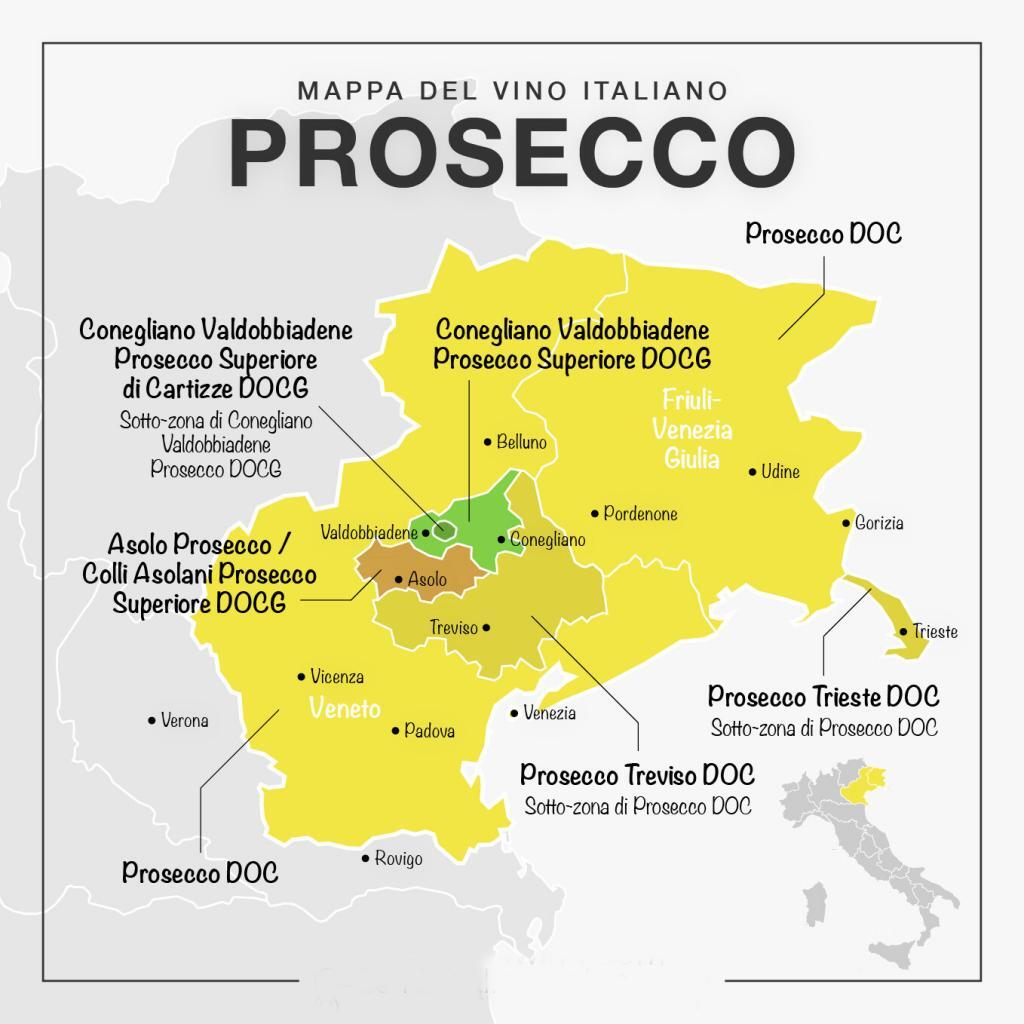
Map showing the Prosecco production zone in north east Italy
A few facts on Prosecco
Prosecco is sometimes called the poor man’s Champagne, but it’s carved a market which sometimes goes beyond the “poor man’s” pocket. While cheaper than Champagne, it’s appreciated by a numerous public and has become Italy’s most exported wine.
The Prosecco grape
The principle grape with which Prosecco is made is called Glera. Recent modifications to the production disciplinary state that the wine must contain at least 85%. The Glera grape has also been called Prosecco, but now the term can only refer to the wine and not the grape. The other grapes which can make up your bottle are; Verdisio, which confers a light bitterness, and Perera which imparts a fruity pear like flavor and aroma. Lastly we have Bianchetta which is used to a “softner” particularly in cold seasons when the grapes may be a little less ripe. Varietals such as Chardonnay, Pinot Gris, and Pinot Noir can also be used, but they are found to a lesser extent.
Prosecco’s long history
Prosecco has become popular in very recent period when compared to most of Italy’s other wines. However the history goes back a long way. The Glera grape has been grown in the Prosecco region since ancient times, and it was used to make a wine called Pucinum. As of 1382, the wine produced in the area took its name from the Prosecco Castle of the time. It was called Pucinum of the noble castle of Prosecco. The name was changed to just Prosecco sometime later.
The Glera grape was also grown in Ancient Rome. In fact in his Natural History, Pliny the Elder who died in 79 AD writes of Livia Augusta (the emperor Augusto’s wife), “she gave the credit for her eighty-six years of life to Pucinum wine.” The first known record of the name Prosecco is from 1593 when the English writer and explorer Fynes Moryson noted ” Here grows the wine Pucinum, now called Prosecco, much celebrated by Pliny.”
The name “prosecco” is actually Slovenian, from prozek, or “path through the woods.” (Prior to being called Prosecco, the region was known as Puccino.) Today, Prosecco production extends a very long way beyond the small village, but this is where it all began.
The Prosecco Appellations of D.O.C – D.O C.G. & Superiore
To protect the name of the wine and production zone from other similar wines being produced in Europe, producers applied for a protected status as of 2009. The initialisms stand for differing levels of quality with the longer of the two being the highest tier. There is a further level of high quality were in adition to D.O.C.G the word Superiore can be used. This can only be used by two very small sub zones which are Conegliano Valdobbiadene and Asolo.
Can I Taste Prosecco During a Tuscany Wine Tour?
As I stated earlier, Prosecco is made in the north east of Italy, but if you book one of my private wine tours you could enjoy a Prosecco tasting in Tuscany as well as Chianti. In fact one of the wineries I regularly visit commercializes a Prosecco from one of the top producers. Just make a point of asking if you’re interested. You can also ship it home if you so wish. They also produce their own dry bubbly rosè from Sangiovese grapes. It’s a big hit with my guests and runs out fast because it’s made in very limited quantities.